Web Slings
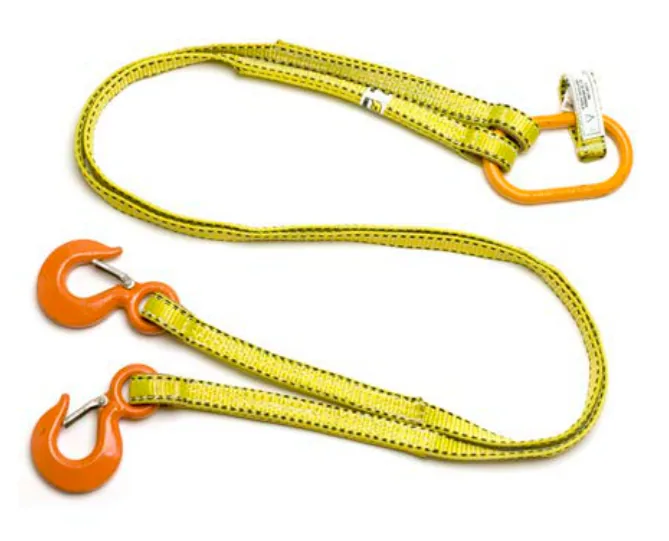
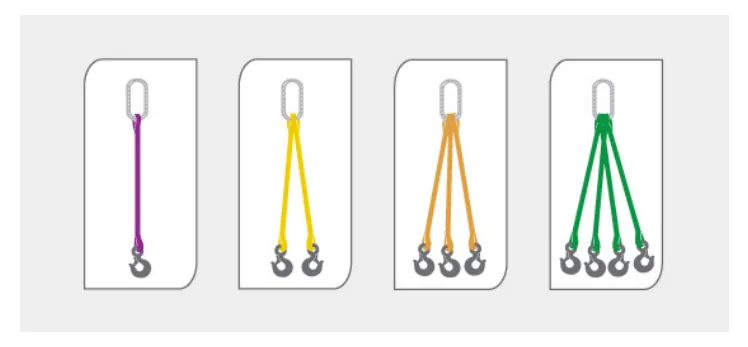
Legs of web sling gathered into one master link, with the fitting you want on the end of each. Stocked as single, double and quadruple leg. A multi-leg bridle picks a load up from several points at once, so it lands level and stays where you put it — which one sling on its own cannot do.
The legs are ordinary eye & eye web slings, and you can see it in the stock number: the capacity of a single-leg SOS-EE292 is the vertical rating of an EE292, because that is exactly what it is — one EE292 with a master link on one end and a hook on the other.
Every bridle is made to order. Tell us the leg length, how many legs, and which fittings you want top and bottom.
Features
- Single, double and quadruple leg
- Built from 1" and 2" eye & eye legs
- Oblong master link or eye sling hook, either end
- 1,600 lb to 22,180 lb depending on legs and angle
- 5:1 design factor per ASME B30.9
- Rated at 60°, 45° and 30°
Related
- Eye & eye — the legs these are built from
- Endless — a continuous loop
- Reversed eye — for abrasive loads
- Chain bridles — when webbing will not survive
Specifications
Tap Add on any line to build a quote list.
Single leg
| Part Number | Top Fitting | Bottom Fitting | Capacity (lbs.) | Quote |
|---|---|---|---|---|
| SOS-EE191 | Oblong Master Link | Eye Sling Hook | 1600 | |
| SOO-EE191 | Oblong Master Link | Oblong Master Link | 1600 | |
| SSS-EE191 | Eye Sling Hook | Eye Sling Hook | 1600 | |
| SOS-EE291 | Oblong Master Link | Eye Sling Hook | 3200 | |
| SOO-EE291 | Oblong Master Link | Oblong Master Link | 3200 | |
| SSS-EE291 | Eye Sling Hook | Eye Sling Hook | 3200 | |
| SOS-EE292 | Oblong Master Link | Eye Sling Hook | 6400 | |
| SOO-EE292 | Oblong Master Link | Oblong Master Link | 6400 | |
| SSS-EE292 | Eye Sling Hook | Eye Sling Hook | 6400 |
Double leg
| Part Number | Top Fitting | Bottom Fittings | Capacity (lbs.) at horizontal angle | Quote | ||
|---|---|---|---|---|---|---|
| 60° | 45° | 30° | ||||
| DOS-EE191 | Oblong Master Link | Eye Sling Hooks | 2770 | 2260 | 1600 | |
| DOO-EE191 | Oblong Master Link | Oblong Master Links | 2770 | 2260 | 1600 | |
| DOS-EE291 | Oblong Master Link | Eye Sling Hooks | 5540 | 4520 | 3200 | |
| DOO-EE291 | Oblong Master Link | Oblong Master Links | 5540 | 4520 | 3200 | |
| DOS-EE292 | Oblong Master Link | Eye Sling Hooks | 11090 | 9050 | 6400 | |
| DOO-EE292 | Oblong Master Link | Oblong Master Links | 11090 | 9050 | 6400 | |
Quadruple leg
| Part Number | Top Fitting | Bottom Fittings | Capacity (lbs.) at horizontal angle | Quote | ||
|---|---|---|---|---|---|---|
| 60° | 45° | 30° | ||||
| QOS-EE191 | Oblong Master Link | Eye Sling Hooks | 5540 | 4520 | 3200 | |
| QOO-EE191 | Oblong Master Link | Oblong Master Links | 5540 | 4520 | 3200 | |
| QOS-EE291 | Oblong Master Link | Eye Sling Hooks | 11090 | 9050 | 6400 | |
| QOO-EE291 | Oblong Master Link | Oblong Master Links | 11090 | 9050 | 6400 | |
| QOS-EE292 | Oblong Master Link | Eye Sling Hooks | 22180 | 18100 | 12800 | |
| QOO-EE292 | Oblong Master Link | Oblong Master Links | 22180 | 18100 | 12800 | |
Angles are measured from the horizontal. The rating falls as the legs flatten out, so a sling rigged at 30° carries little more than half what the same sling carries at 60°. Never rig below 30°. Capacities assume the load is shared evenly between the legs.
How to read the stock number
A bridle’s stock number is three letters, a dash, and the sling its legs are made from. DOS-EE292 is a double-leg bridle, oblong master link on top, eye sling hooks on the bottom, built from 2 ply 2" eye & eye.
- First letter — legs
- S single, D double, Q quadruple.
- Second letter — top fitting
- O oblong master link, S eye sling hook. The master link is what goes in the crane hook.
- Third letter — bottom fitting
- Same two letters, for whatever lands on the load. SOO is a single leg with a master link at both ends; SSS has a sling hook at both ends.
- After the dash — the leg
- The eye & eye sling each leg is built from. EE191 is 1 ply 1", EE291 is 2 ply 1", EE292 is 2 ply 2". Its vertical rating is the single-leg capacity of the bridle.
Leg length is not in the stock number because every bridle is made to order. Give us the length you want each leg to measure, and say if the legs are not all the same.
Why the angle matters
Two legs do not carry twice one leg. They carry twice one leg multiplied by the sine of the angle the legs make with the horizontal, and that is where riggers get caught out. The further the legs lean out from vertical, the more of the load turns into tension pulling the legs toward each other, and the less of it goes into lifting.
- 60°
- Legs fairly upright. About 87% of what the legs would carry hanging straight down — the most you will get out of a bridle in practice.
- 45°
- About 71%. The common working compromise, and the angle most people picture when they imagine a bridle.
- 30°
- Exactly half. Two legs at 30° carry no more than one leg hanging vertically, which surprises people every time.
Below 30° the numbers fall away fast and the standard stops: ASME B30.9 says a sling is not to be used at an angle of loading under 30° unless the sling manufacturer or a qualified person says otherwise. If the legs are that flat, the answer is longer legs or a spreader beam, not a bigger sling.
Angles here are measured from the horizontal — the angle between the leg and the top of the load. Some charts measure from the vertical instead, and the two are easy to confuse. Read the column header before you read the number.
Loading a four-leg bridle
A four-leg bridle is rated as though all four legs take an equal share. On a rigid load, they often do not. Unless the pick points are placed so the load is genuinely symmetrical, a rigid load will settle onto two diagonal legs and leave the other two along for the ride — and those two legs are then carrying a load rated for four.
ASME B30.9 covers this in two places worth knowing. No leg may ever be loaded beyond its own single-leg rating, whatever the bridle is rated as a whole. And where a multiple-leg sling is used on a load that is not symmetrical, the standard asks for an analysis by a qualified person to keep any one leg from being overloaded.
In practice a four-leg bridle is there for stability and a level lift, not for four legs’ worth of capacity. If you need the capacity, size the sling as though fewer legs are doing the work, or give us the load and the pick points and we will work it out with you.
When to take one out of service
ASME B30.9 asks for a visual inspection every shift before the sling is used, and a documented periodic inspection at intervals set by how hard the sling works. A bridle has more to check than a single sling — every leg, the master link and every hook. Any one of the following takes the whole assembly out of service until a qualified person says otherwise.
Damage to the webbing
- Acid or caustic burns
- Melting or charring anywhere on the sling
- Holes, tears, cuts or snags
- Excessive abrasive wear
- Knots in any part of the sling
- Discoloration, or brittle or stiff areas — which can mean chemical or UV damage
Fittings and marking
- Missing or illegible tag
- Broken or worn stitching in a load-bearing splice
- Master link or hooks pitted, corroded, cracked, bent, twisted, gouged or broken
- Hooks missing or with a damaged latch
- Any other visible damage that leaves you in doubt
A damaged web sling is not a field repair. Only the sling manufacturer or a qualified person may repair one, and a load-bearing splice cannot be repaired at all. Criteria from ASME B30.9-2025, Chapter 9-5. We inspect and we train — see rigging inspection and rigging training.
Need a price or a lead time?
Most stocked items ship the same day from Hatfield. Call and we’ll confirm what’s on the shelf.