Web Slings
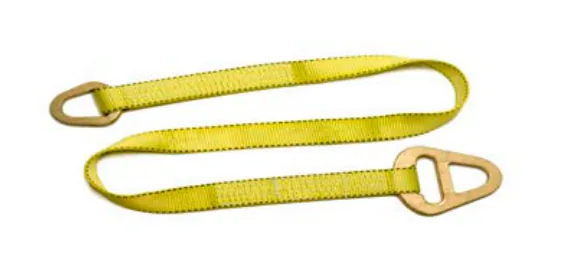
A plain triangle on one end, a slotted triangle on the other. ASME B30.9 calls it a Type I sling, and it is the one web sling that will do all three hitches without you ever putting webbing over a hook: vertical, basket, and — by feeding the body through the slot — choker.
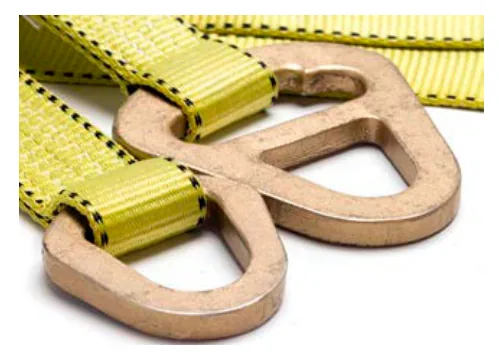
The fittings are the point. Every lift bears on steel rather than on the webbing itself, so the part that normally wears out first is not in the load path at all. That buys a lot of life in a shop where slings get choked around castings and weldments all day, and it makes the sling quicker to rig because the fittings seat in a hook the same way every time.
Made to order. Pick the width and ply and tell us the length in the quote.
Features
- Type I — triangle one end, choker triangle the other
- 2" to 6" web width, 1 or 2 ply
- 3,200 lb to 17,000 lb vertical
- 5:1 design factor per ASME B30.9
- Fittings rated to 2× the sling’s rated load
- Vertical, choker and basket from one sling
Related
- Eye & eye — flat eyes, no hardware
- Endless — a continuous loop
- Reversed eye — wear pad over the whole body
- Web bridles — two, three and four leg
Specifications
Tap Add on any line to build a quote list.
| # of Plys | Part Number | Web Width (Inches) | Rated Capacity (lbs.) Vertical | Choke | Basket | Min. Standard Length (ft) | Quote |
|---|---|---|---|---|---|---|---|
| 1 | TC1-902 | 2 | 3,200 | 2,500 | 6,400 | 3 | |
| — | TC1-903 | 3 | 4,800 | 3,800 | 9,600 | 3 | |
| — | TC1-904 | 4 | 6,400 | 5,000 | 12,800 | 3 | |
| — | TC1-906 | 6 | 9,600 | 7,600 | 19,200 | 3 | |
| 2 | TC2-902 | 2 | 6,400 | 5,000 | 12,800 | 3 | |
| — | TC2-903 | 3 | 8,900 | 7,200 | 17,800 | 3 | |
| — | TC2-904 | 4 | 12,000 | 9,600 | 24,000 | 3 | |
| — | TC2-906 | 6 | 17,000 | 13,000 | 34,000 | 3 |
Basket capacity is twice the vertical rating with the legs hanging straight down; any angle off vertical reduces it. Choker figures are the manufacturer’s published values — read the row rather than applying a rule of thumb.
How the choke works
The slotted triangle is what separates this sling from a plain two-triangle sling. Pass the body of the sling through the slot and you have a choker that tightens on the load as it lifts, with the steel fitting taking the bearing instead of the webbing.
- Vertical
- Straight pull — hook into the plain triangle, load on the other end. The sling’s full rating, and the figure every other hitch is worked out from.
- Choker
- Body through the slotted triangle, drawn up around the load. Grips a loose or awkward load, and does not hold it against rotation. Rated below vertical because the sling bends sharply on itself at the choke.
- Basket
- Both fittings into the hook, load cradled in the bight. Twice the vertical rating with the legs straight down, less at any angle.
ASME B30.9 also recognises a Type II sling — a plain triangle on both ends. It looks similar but has no slot, so it will do vertical and basket only, never a choke. If you are replacing a sling, check which one you actually have before you order.
The fittings
ASME B30.9 sets two requirements for a fitting on a web sling, and both matter more here than on any other web sling because this one is defined by its hardware.
- Strength
- A fitting must sustain twice the sling’s rated load with no visible permanent deformation. A triangle that has opened up, bent or twisted has failed that test and takes the sling out of service.
- Finish
- Any surface the fitting presents to the webbing has to be finished so there is no edge that could cut it. This is why a gouged or corroded triangle is a removal condition even when the sling itself looks perfect — the damage will transfer into the webbing.
Check the fittings every time you check the webbing. Pitting, corrosion, cracks, bends, twists, gouges and breaks are all removal conditions in their own right.
When to take one out of service
ASME B30.9 asks for a visual inspection every shift before the sling is used, and a documented periodic inspection at intervals set by how hard the sling works. A sling showing any of the following comes out of service, and does not go back until a qualified person says so.
Damage to the webbing
- Acid or caustic burns
- Melting or charring anywhere on the sling
- Holes, tears, cuts or snags
- Excessive abrasive wear
- Knots in any part of the sling
- Discoloration, or brittle or stiff areas — which can mean chemical or UV damage
Fittings and marking
- Missing or illegible tag
- Broken or worn stitching in a load-bearing splice
- Fittings pitted, corroded, cracked, bent, twisted, gouged or broken
- Any other visible damage that leaves you in doubt about the sling
A damaged web sling is not a field repair. Only the sling manufacturer or a qualified person may repair one, and a load-bearing splice cannot be repaired at all. Criteria from ASME B30.9-2025, Chapter 9-5. We inspect and we train — see rigging inspection and rigging training.
Need a price or a lead time?
Most stocked items ship the same day from Hatfield. Call and we’ll confirm what’s on the shelf.