Web Slings
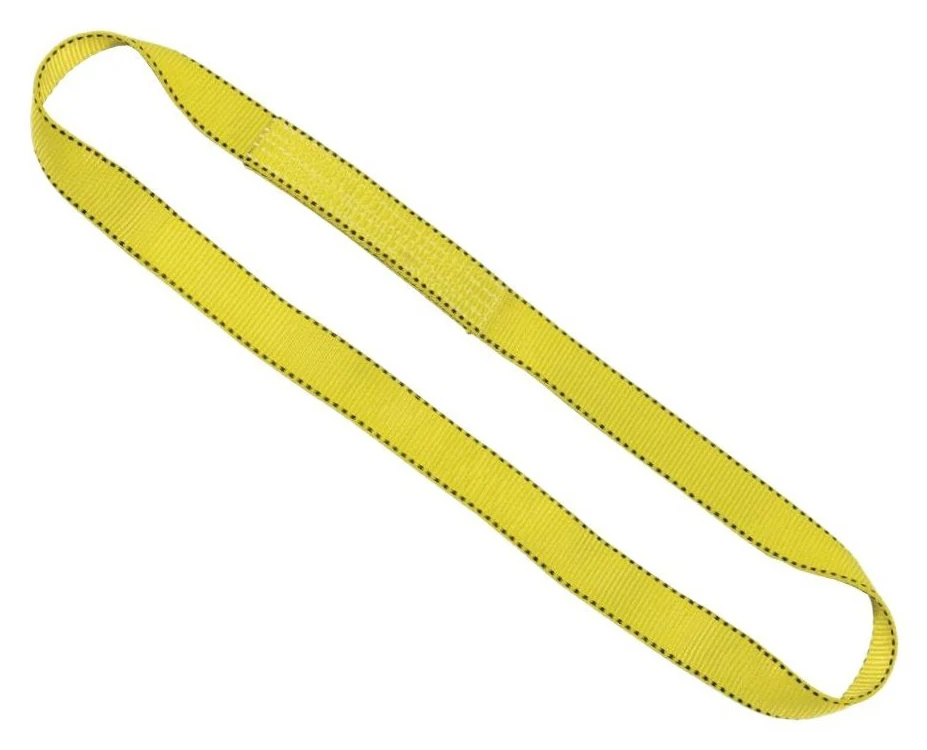
A continuous loop with no eyes and no hardware — the two ends of the webbing joined by a stitched splice. ASME B30.9 calls it a Type V; most people call it a grommet or just an endless.
Because the loop puts two thicknesses of webbing in the pull, an endless carries more than the same width and ply of eye & eye. Compare any row below against the eye & eye table and you will see it. It also has no eyes to wear out, which is the usual failure point on a flat sling.
The real advantage is that there is no fixed bearing point. Rotate the sling a few inches between lifts and the wear moves with it, so the whole loop shares the work rather than one spot taking all of it. That habit alone will outlast a second sling.
Features
- Type V — continuous loop, no hardware
- 1" to 6" web width, 1 through 4 ply
- 3,200 lb to 50,500 lb vertical
- 5:1 design factor per ASME B30.9
- No eyes to wear out
- Rotate between lifts to spread wear
Related
- Eye & eye — flat eyes, more versatile
- Reversed eye — wear pad over the whole body
- Triangle choker — steel fittings on both ends
- Endless round slings — the same idea in a round sling
Specifications
Tap Add on any line to build a quote list.
| # of Plys | Part No. | Web Width (Inches) | Rated Capacity (lbs.) Vertical | Choke | Basket | Min. Standard Length (ft) | Approximate Sling Weight (lbs.) Base | Adder/ft. | Quote |
|---|---|---|---|---|---|---|---|---|---|
| 1 | EN191 | 1 | 3,200 | 2,500 | 6,400 | 3 | .40 | — | |
| — | EN192 | 2 | 6,400 | 5,000 | 12,800 | 3 | .80 | — | |
| — | EN193 | 3 | 8,600 | 6,900 | 17,200 | 3 | 1.30 | — | |
| — | EN194 | 4 | 11,500 | 9,200 | 23,000 | 3 | 1.70 | — | |
| — | EN196 | 6 | 16,300 | 13,000 | 32,600 | 3 | 2.50 | — | |
| 2 | EN291 | 1 | 6,200 | 4,900 | 12,400 | 3 | .80 | — | |
| — | EN292 | 2 | 12,200 | 9,800 | 24,400 | 3 | 1.60 | — | |
| — | EN293 | 3 | 16,300 | 13,000 | 32,600 | 3 | 2.50 | — | |
| — | EN294 | 4 | 20,700 | 16,500 | 41,400 | 3 | 3.30 | — | |
| — | EN296 | 6 | 28,600 | 23,000 | 57,200 | 3 | 4.90 | — | |
| 3 | EN391 | 1 | 8,000 | 6,400 | 16,000 | 3 | 1.20 | — | |
| — | EN392 | 2 | 16,000 | 12,800 | 32,000 | 3 | 2.40 | — | |
| — | EN393 | 3 | 21,500 | 17,200 | 43,000 | 3 | 3.60 | — | |
| — | EN394 | 4 | 28,700 | 23,000 | 57,400 | 3 | 4.80 | — | |
| — | EN396 | 6 | 40,700 | 32,500 | 81,400 | 3 | 7.20 | — | |
| 4 | EN491 | 1 | 10,000 | 8,000 | 20,000 | 3 | 1.60 | — | |
| — | EN492 | 2 | 19,800 | 15,800 | 39,600 | 3 | 3.20 | — | |
| — | EN493 | 3 | 26,700 | 21,300 | 53,400 | 3 | 4.90 | — | |
| — | EN494 | 4 | 35,600 | 28,400 | 71,200 | 3 | 6.50 | — | |
| — | EN496 | 6 | 50,500 | 40,400 | 101,000 | 3 | — | — |
Basket capacity is twice the vertical rating with the legs hanging straight down; any angle off vertical reduces it. Choker figures are the manufacturer’s published values — read the row rather than applying a rule of thumb. Length on an endless sling is the loop laid flat, not the circumference.
How to read the stock number
The stock number describes the whole sling. EN292 reads as endless, 2 ply, 9 series webbing, 2" wide.
- EN
- Endless — a continuous loop with no eyes. ASME Type V.
- First digit
- Number of plies: layers of webbing stacked and stitched together. Note this is plies of webbing, not the doubling you get from the loop itself — that is already in the rating.
- 9
- The webbing series, which sets the strength per inch of width.
- Last digit
- Web width in inches — 1, 2, 3, 4 or 6.
Length is not in the stock number because every sling is made to order. Give us the length you want the loop to measure laid flat.
How an endless behaves
- No bearing point
- Nothing on an endless sling is obliged to take the hook in the same place twice. Shift it between lifts and the wear spreads over the whole loop instead of concentrating where the eyes would be.
- No eyes, no splice in the throat
- On a flat sling the loop eye and its splice are the parts working against steel on every pick. An endless has neither, so the commonest retirement condition simply is not there.
- It will not stay put
- The same thing that spreads the wear lets the sling creep and roll on a smooth load. Where the sling must stay exactly where you set it, a flat eye gives you more control.
- One splice, and it matters
- The whole sling depends on a single load-bearing splice. Broken or worn stitching there is an immediate removal condition, and it is not repairable — so find the splice and look at it every time.
When to take one out of service
ASME B30.9 asks for a visual inspection every shift before the sling is used, and a documented periodic inspection at intervals set by how hard the sling works. A sling showing any of the following comes out of service, and does not go back until a qualified person says so.
Damage to the webbing
- Acid or caustic burns
- Melting or charring anywhere on the sling
- Holes, tears, cuts or snags
- Excessive abrasive wear
- Knots in any part of the sling
- Discoloration, or brittle or stiff areas — which can mean chemical or UV damage
Everything else
- Missing or illegible tag
- Broken or worn stitching in the load-bearing splice
- Fittings pitted, corroded, cracked, bent, twisted, gouged or broken
- Any other visible damage that leaves you in doubt about the sling
A damaged web sling is not a field repair. Only the sling manufacturer or a qualified person may repair one, and a load-bearing splice cannot be repaired at all. Criteria from ASME B30.9-2025, Chapter 9-5. We inspect and we train — see rigging inspection and rigging training.
Need a price or a lead time?
Most stocked items ship the same day from Hatfield. Call and we’ll confirm what’s on the shelf.