Web Slings
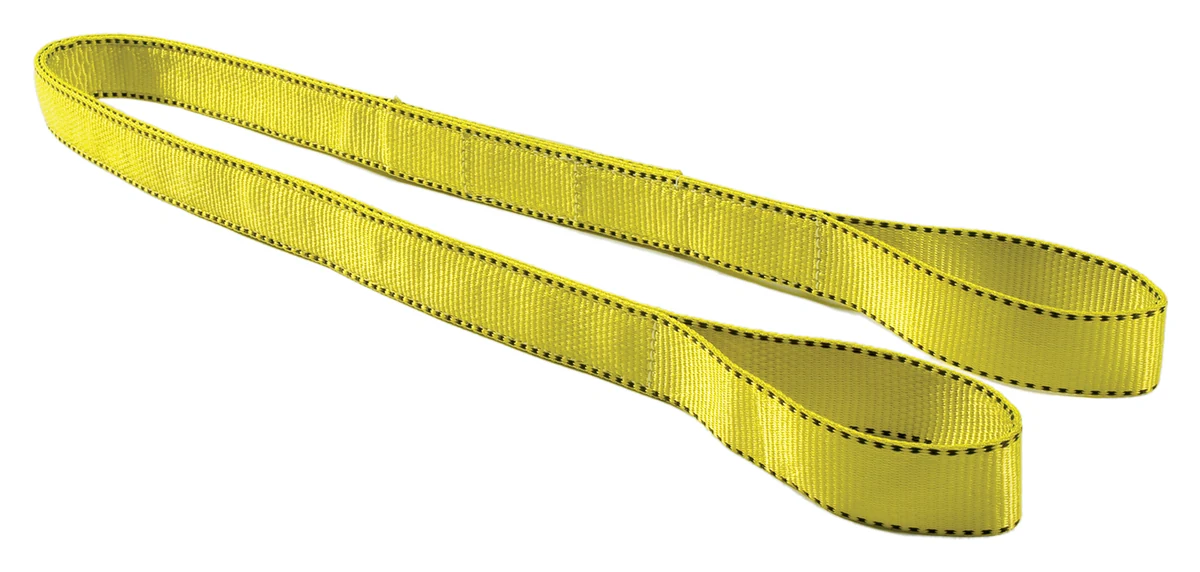
A flat loop eye on each end, both lying in the same plane as the body. ASME B30.9 calls this a Type III sling; everyone on a jobsite calls it an eye & eye, and it is the web sling most general lifting asks for. Pull it vertically, choke it, or basket it — the table below gives all three ratings.
Webbing is the gentlest of the sling materials. It conforms to whatever it is wrapped around, spreads its grip across a wide bearing surface, and will not mar machined or painted work the way chain or wire rope will. It is light enough to rig by hand all day. The trade is that webbing is cut by sharp edges, weakened by the wrong chemicals and degraded by sunlight — none of which bother a chain sling. Protect the corners, keep it out of the weather, and a web sling lasts.
Every sling on this page is made to order. Pick the width and the ply you need and tell us the length in the quote.
Features
- Type III flat eye on both ends
- 1" to 6" web width, 1 through 4 ply
- 1,600 lb to 33,000 lb vertical
- 5:1 design factor per ASME B30.9
- Additional wear pad in the eyes on 2" slings
- Tagged with the rated load for each hitch
- Cut to any length
Options
- Nylon or polyester webbing
- Twisted (Type IV) eyes
- Sleeves and wear pads on the body
- Endless and reversed eye
- Two, three and four leg bridles
Specifications
Tap Add on any line to build a quote list.
| # of Plys | Part No. | Web Width (Inches) | Rated Capacity (lbs.) Vertical | Choke | Basket | Eye Dimensions (inches) Width | Length | Min. Standard Length (ft) | Approximate Sling Weight (lbs.) Base | Adder/ft. | Quote |
|---|---|---|---|---|---|---|---|---|---|---|---|
| 1 | EE191 | 1 | 1,600 | 1,250 | 3,200 | 1 | 9 | 3 | .40 | .06 | |
| — | EE192 | 2 | 3,200 | 2,500 | 6,400 | 2 | 9 | 4 | .90 | .12 | |
| — | EE193 | 3 | 4,800 | 3,800 | 9,600 | 1-1/2 | 9 | 4 | 1.40 | .18 | |
| — | EE194 | 4 | 6,400 | 5,000 | 12,800 | 2 | 12 | 4 | 1.90 | .24 | |
| — | EE196 | 6 | 9,300 | 7,440 | 18,600 | 2 | 14 | 5 | 3.40 | .36 | |
| 2 | EE291 | 1 | 3,200 | 2,500 | 6,400 | 1 | 9 | 3 | .40 | .13 | |
| — | EE292 | 2 | 6,400 | 5,000 | 12,800 | 2 | 9 | 3 | .90 | .25 | |
| — | EE293 | 3 | 9,300 | 7,440 | 18,600 | 1-1/2 | 12 | 4 | 1.70 | .38 | |
| — | EE294 | 4 | 11,500 | 9,200 | 23,000 | 2 | 12 | 4 | 2.30 | .50 | |
| — | EE296 | 6 | 16,500 | 13,200 | 33,000 | 2 | 14 | 6 | 4.90 | .76 | |
| 3 | EE391 | 1 | 4,100 | 3,280 | 8,200 | 1 | 12 | 4 | 1.0 | .20 | |
| — | EE392 | 2 | 8,300 | 6,640 | 16,600 | 2 | 12 | 4 | 2.10 | .40 | |
| — | EE393 | 3 | 12,500 | 10,000 | 25,000 | 1-1/2 | 18 | 5 | 3.70 | .59 | |
| — | EE394 | 4 | 16,000 | 12,800 | 32,000 | 2 | 18 | 5 | 5.00 | .79 | |
| — | EE396 | 6 | 23,000 | 18,400 | 46,000 | 3 | 20 | 5 | 7.60 | 1.2 | |
| 4 | EE491 | 1 | 6,200 | 4,960 | 12,400 | 1 | 12 | 4 | 1.10 | .26 | |
| — | EE492 | 2 | 12,400 | 9,920 | 24,800 | 2 | 12 | 4 | 2.20 | .53 | |
| — | EE493 | 3 | 17,000 | 13,600 | 34,000 | 1-1/2 | 18 | 5 | 4.10 | .79 | |
| — | EE494 | 4 | 22,000 | 17,600 | 44,000 | 2 | 18 | 5 | 5.50 | 1.1 | |
| — | EE496 | 6 | 33,000 | 26,400 | 66,000 | 3 | 20 | 5 | 8.30 | 1.6 |
Basket capacity is twice the vertical rating, with the legs hanging straight down; any angle off vertical reduces it. Choker capacity is 80% of vertical on most sizes and a little under that on a few, so read the figure in the row rather than working it out. Lengths are measured bearing point to bearing point — the inside of one eye to the inside of the other.
The eye is what wears out
On a sling that is otherwise looked after, the eye goes first. It is the part bearing on a hook or a shackle pin on every single lift, working against steel while the body of the sling is working against the load.

How to read the stock number
The stock number describes the whole sling. EE292 reads as eye & eye, 2 ply, 9 series webbing, 2" wide.
- EE
- Eye and eye — a flat loop eye on each end, both on the plane of the body. ASME Type III.
- First digit
- Number of plies: layers of webbing stacked and stitched together. More plies carry more at the same width, and a 2 ply 2" sling does the work of a 1 ply 4" in half the width.
- 9
- The webbing series, which sets the strength per inch of width. Everything in the table above is 9 series.
- Last digit
- Web width in inches — 1, 2, 3, 4 or 6.
Length is not in the stock number because every sling is cut to order, so give it to us separately.
Nylon or polyester
The two look alike and rate alike. What separates them is what you are taking the sling into.
- Nylon
- Resists alkalis. Attacked by acids. Stretches more than polyester under load, which takes some of the shock out of a pick.
- Polyester
- Resists acids and bleaching agents. Attacked by strong alkalis at high temperature. Stretches less, so the load stays closer to where you put it.
Neither goes above 194°F (90°C) or below −40°F (−40°C), and that limit covers the sling touching a hot object as much as the air around it. If a sling is going near process chemicals, tell us which ones and we will check it before we build it rather than after.
When to take one out of service
ASME B30.9 asks for a visual inspection every shift before the sling is used, and a documented periodic inspection at intervals set by how hard the sling works. A sling showing any of the following comes out of service, and does not go back until a qualified person says so.
Damage to the webbing
- Acid or caustic burns
- Melting or charring anywhere on the sling
- Holes, tears, cuts or snags
- Excessive abrasive wear
- Knots in any part of the sling
- Discoloration, or brittle or stiff areas — which can mean chemical or UV damage
Everything else
- Missing or illegible tag
- Broken or worn stitching in a load-bearing splice
- Fittings pitted, corroded, cracked, bent, twisted, gouged or broken
- Any other visible damage that leaves you in doubt about the sling
A damaged web sling is not a field repair. Only the sling manufacturer or a qualified person may repair one, and a load-bearing splice cannot be repaired at all. Criteria from ASME B30.9-2025, Chapter 9-5. We inspect and we train — see rigging inspection and rigging training.
Need a price or a lead time?
Most stocked items ship the same day from Hatfield. Call and we’ll confirm what’s on the shelf.